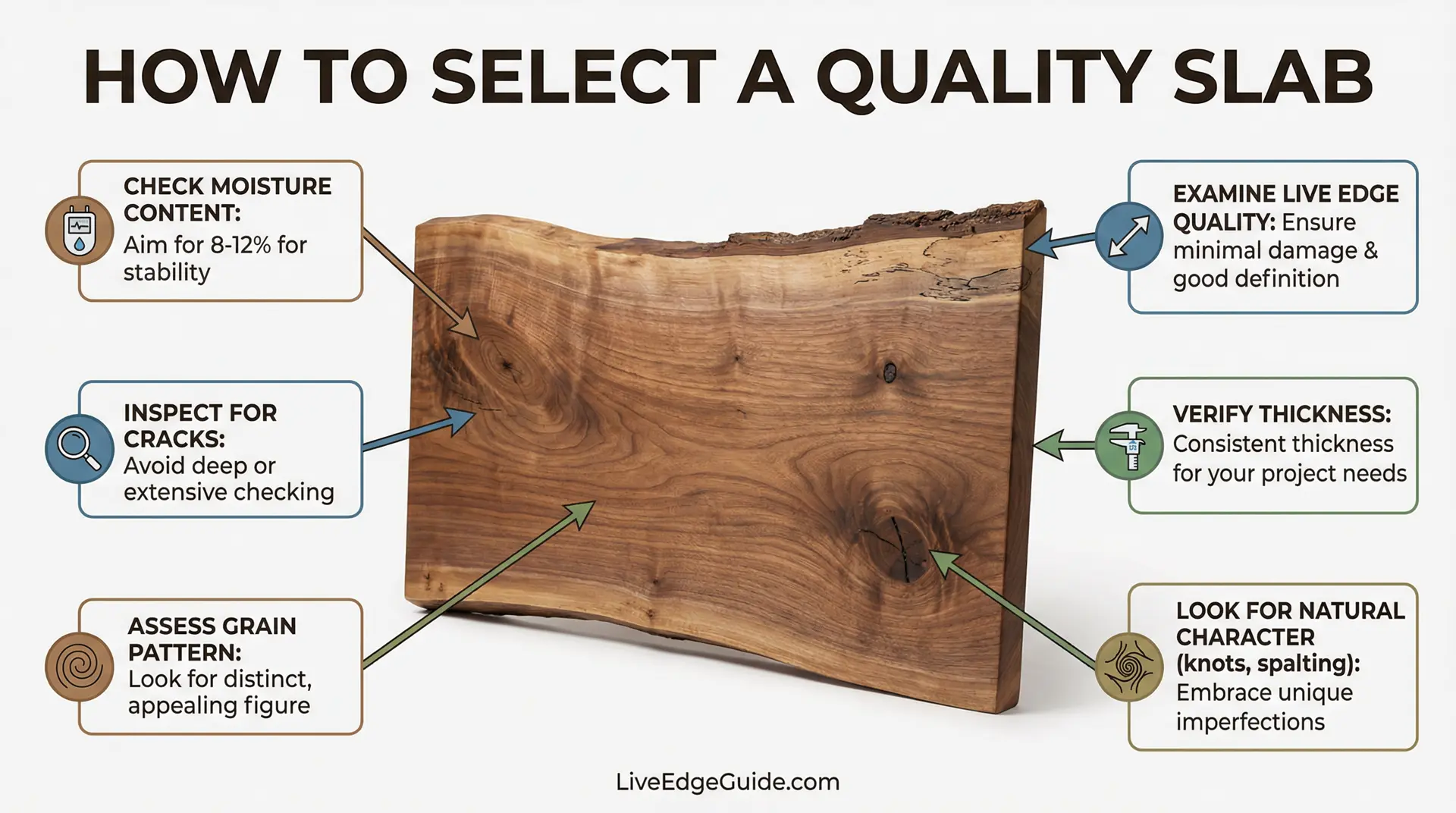
The Complete Live Edge Slab Buying Checklist
Buying a live edge slab is a $2,000-$10,000 investment. Unfortunately, the market is full of "garage wood"—slabs that will crack, warp, or split within months of delivery.
This checklist is your defense. Print it. Bring it to the showroom. If a seller can't answer these questions, do not buy.
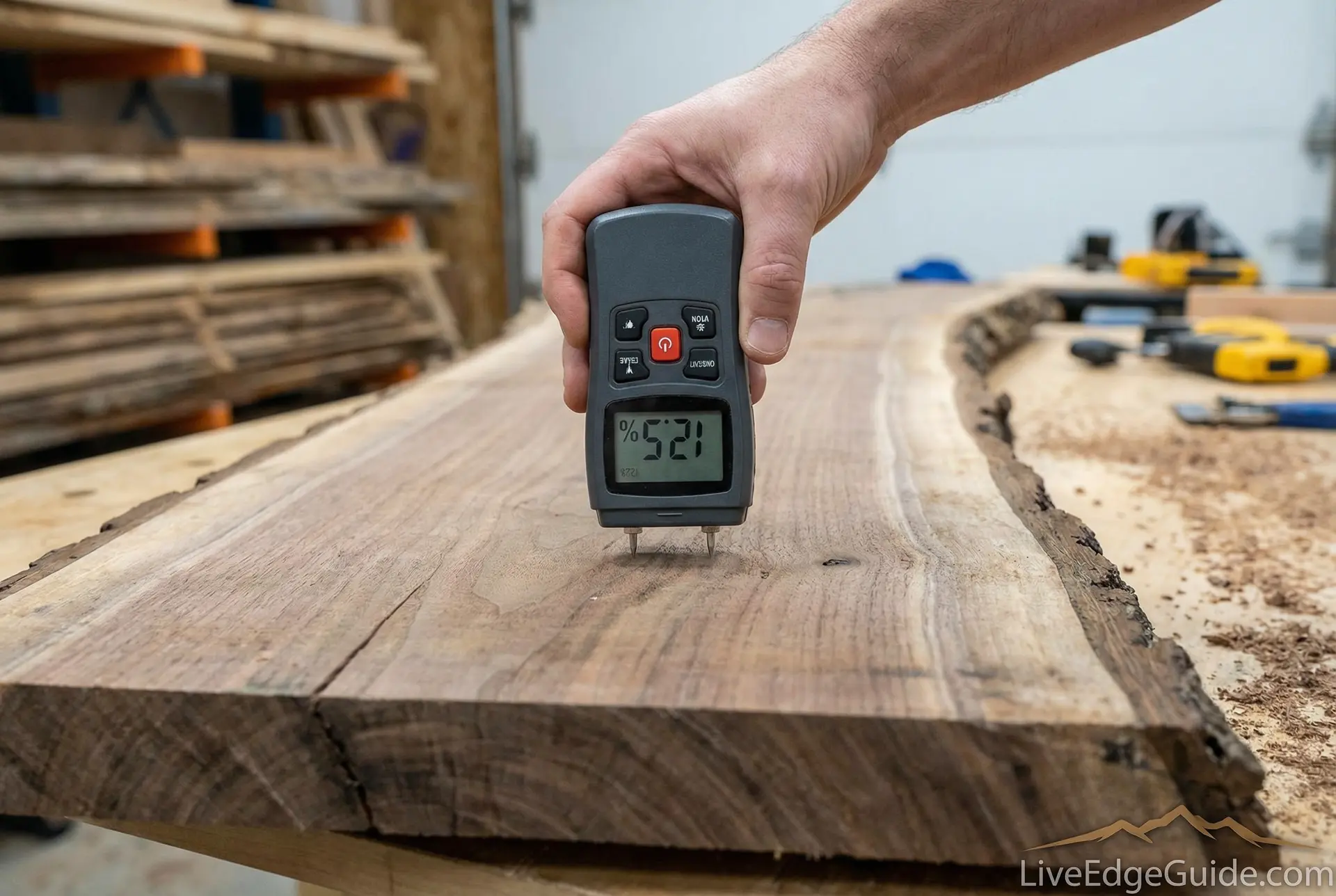
✅ 1. Moisture Content (The #1 Deal-Breaker)
What to Ask:
"Can I see a moisture meter reading?"
What You Need:
- 6-8% moisture content for indoor furniture
- Reading taken from the center of the slab (not the edge)
Red Flags:
- ❌ "It's air-dried" (Air drying stops at 12-15%, which is too wet)
- ❌ Seller refuses to test it
- ❌ Reading above 10%
Why It Matters:
Texas homes with AC run at 30-50% relative humidity. A slab at 12% moisture will shrink, crack, and cup as it acclimates. Read more about warping.
✅ 2. Flattening & Surfacing
What to Ask:
"Has this been flattened on both sides?"
What You Need:
- Both faces should be parallel and flat
- No visible cupping or twisting
- Smooth surface (no rough saw marks)
Red Flags:
- ❌ "We can flatten it for an extra $500" (This should be included)
- ❌ Visible twist when you sight down the length
- ❌ Rough chainsaw marks still visible
Why It Matters:
An unflattened slab will rock on the table base. Professional flattening requires a CNC router or slab flattening jig.
✅ 3. Cracks, Checks & Structural Integrity
What to Ask:
"Are there any cracks that go all the way through?"
What's Acceptable:
- ✅ Small surface checks (can be filled with epoxy)
- ✅ End checks (normal, will be cut off)
Red Flags:
- ❌ Through-cracks that run the full thickness
- ❌ Cracks at the pith (center of the tree) that are spreading
- ❌ Multiple large voids without a plan to stabilize them
Why It Matters:
Small cracks are character. Large structural cracks will continue to spread and can't be fixed.
✅ 4. Bark & Live Edge Condition
What to Ask:
"Has the bark been removed and the edge cleaned?"
What You Need:
- Bark should be removed (it will fall off over time)
- Edge should be sanded smooth (no sharp splinters)
- Cambium layer (the soft layer under bark) should be cleaned
Red Flags:
- ❌ Loose bark still attached
- ❌ Punky, soft wood at the edge
- ❌ Sharp, splintery edges
✅ 5. Sapwood vs. Heartwood Balance
What to Look For:
- Heartwood: The dark, dense center (most durable)
- Sapwood: The lighter outer rings (softer, can be prone to bugs if not kiln-dried)
Ideal Balance:
- A mix of both creates visual contrast
- Too much sapwood = less durability
- All heartwood = less character
Red Flags:
- ❌ Sapwood with visible insect damage
- ❌ Sapwood that's punky or soft to the touch
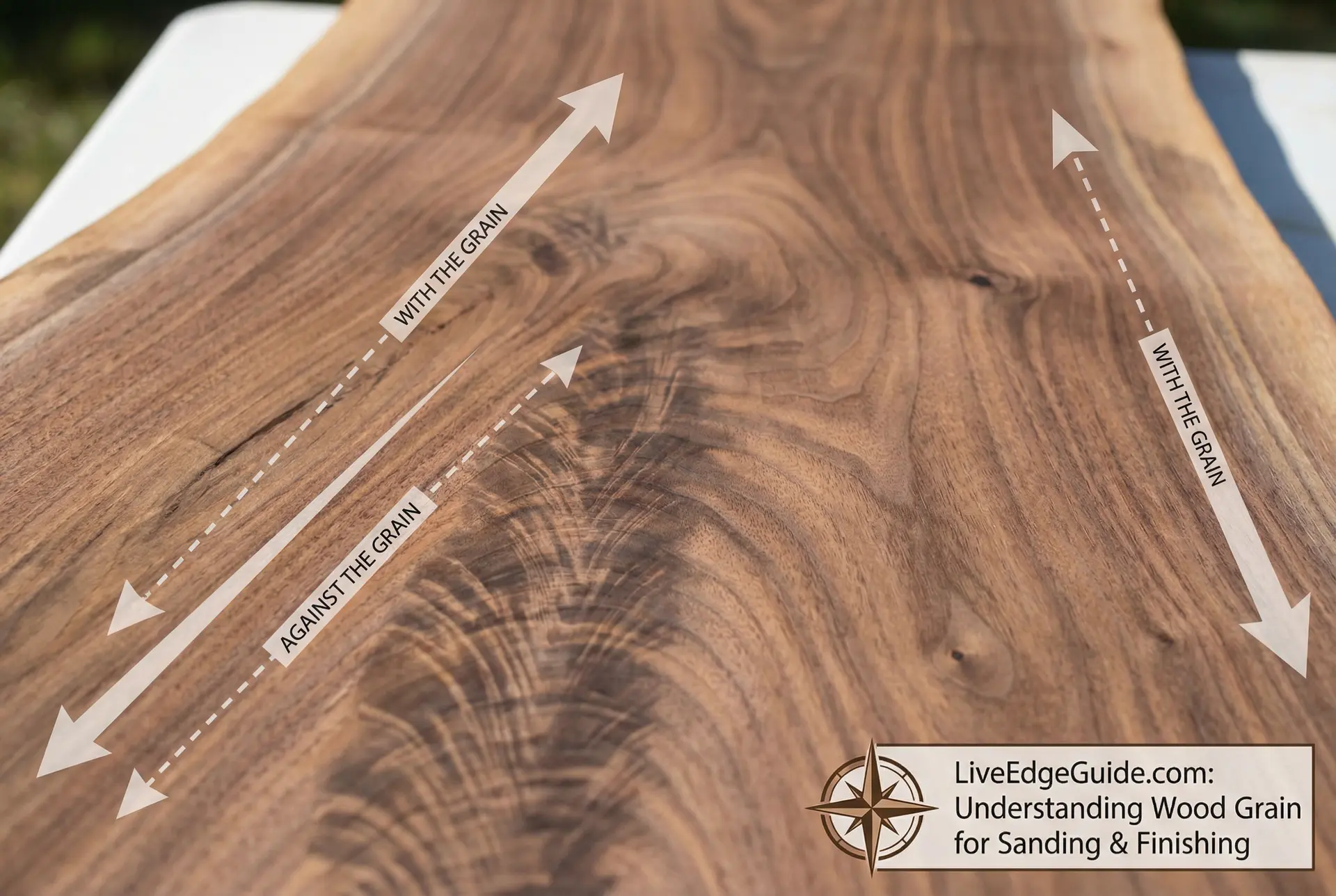
✅ 6. Grain Pattern & Figure
What to Ask:
"Can I see the grain under different lighting?"
What to Look For:
- Cathedral grain: Arching patterns (most common)
- Quilted or curly grain: Premium, adds value
- Burl: Chaotic swirls (rare, expensive)
Pro Tip:
Wet the surface with a damp cloth to preview what it will look like under finish.
✅ 7. Dimensions & Usability
What to Measure:
- Length: Measure the usable length (not including cracked ends)
- Width: Measure at the narrowest point
- Thickness: Should be at least 1.75-2 inches for dining tables
Red Flags:
- ❌ Slab is too thin (under 1.5") for structural use
- ❌ Width varies dramatically (makes base design difficult)
✅ 8. Species Verification
What to Ask:
"What species is this, and can you verify it?"
Common Species:
- Parota (Guanacaste): Light amber, fast-growing, sustainable
- Black Walnut: Dark chocolate brown, premium pricing
- White Oak: Light tan with ray fleck, very hard
- Pecan/Mesquite: Texas natives, lots of character
Red Flags:
- ❌ Seller can't identify the species
- ❌ "Mystery wood" pricing
✅ 9. Kiln Schedule & Drying Method
What to Ask:
"Was this vacuum kiln dried or dehumidification kiln dried?"
Best Methods:
- ✅ Vacuum kiln: Best for thick slabs and exotic species
- ✅ Dehumidification kiln: Standard for domestic hardwoods
Red Flags:
- ❌ "Solar kiln" (too slow, inconsistent)
- ❌ "Air dried only" (not suitable for indoor furniture)
✅ 10. Pricing Transparency
What to Ask:
"What's the price per board foot, and what does that include?"
What Should Be Included:
- ✅ Kiln drying
- ✅ Flattening (both sides)
- ✅ Edge cleaning
Red Flags:
- ❌ "Call for price" (legitimate sellers post pricing)
- ❌ Prices significantly below market ($20/bf for Walnut is a scam)
Market Rates (2025):
- Parota: $15-25/board foot
- Black Walnut: $50-80/board foot
- White Oak: $30-50/board foot
✅ 11. Return Policy & Warranty
What to Ask:
"What happens if this warps in my home?"
What You Need:
- Written moisture content guarantee
- At least 30-day inspection period
- Clear return/exchange policy
Red Flags:
- ❌ "All sales final" on kiln-dried wood
- ❌ No written documentation
✅ 12. Seller Reputation & Facility
What to Verify:
- ✅ Physical showroom you can visit
- ✅ Industrial kiln on-site (or proof of kiln drying)
- ✅ Professional flattening equipment
- ✅ Online reviews from real customers
Red Flags:
- ❌ Selling from a residential garage
- ❌ No kiln on-site ("we send it out")
- ❌ No online presence or reviews
The "Walk Away" Test
If a seller exhibits 3 or more of these red flags, do not buy:
- Won't test moisture content
- No kiln on-site
- Prices too good to be true
- Refuses to answer technical questions
- "All sales final" policy
- Can't identify wood species
- Slab has major structural cracks
- No professional flattening equipment
Ready to Buy?
Use this checklist at every showroom. The right slab will check every box. Don't settle.
Recommended DFW Sellers:
- Kovara (Arlington) - Kiln-dried Parota specialists
- Phillips Forest Products - Volume kiln-dried inventory
- Urban Tree Merchants - Local salvaged wood
Need Expert Guidance?
Bring this checklist to your next slab shopping trip, or consult with our team for a technical audit.
Contact an Expert