The Ultimate Live Edge Wood Guide
Live edge furniture has transcended trend status to become a staple of modern interior design. It bridges the gap between the raw beauty of nature and the refined elegance of custom craftsmanship. In this comprehensive guide, we will explore everything you need to know about live edge wood—from how it's sourced and dried to selecting the perfect species for your home.
The Philosophy of Live Edge: From Trees to Temples
To understand why live edge furniture is so prized today, we must look back at its philosophical roots. While the "natural edge" has been used since humanity first fashioned tools from fallen logs, the modern movement was ignited by George Nakashima, a Japanese-American woodworker and architect.
The World of George Nakashima
Nakashima viewed himself as a "healer" of trees. His philosophy, detailed in his seminal book The Soul of a Tree, posited that every tree has a second life as furniture. He believed that the craftsman's duty was to provide that second life with as much dignity and beauty as possible.
- Wabi-Sabi: His work embraced the Japanese aesthetic of Wabi-Sabi—finding beauty in imperfection, aging, and the cycle of nature.
- The Butterfly Joint: He popularized the use of "butterfly" or "bowtie" joints to stabilize natural checks and cracks, turning structural necessities into decorative signatures.
Today, choosing a live edge table is a rejection of mass-produced, "disposable" furniture culture. It is an embrace of longevity, organic movement, and a direct connection to the ancient forests from which these slabs were harvested.
What is Live Edge?
Unlike traditional lumber, which is milled into uniform rectangular boards, live edge slabs preserve the natural contour of the tree's outer surface. This means every single piece is unique, telling the story of the tree's life through its shape, grain, and imperfections.
The Anatomy of a Slab: More Than Just Wood
A premium live edge slab is a window into the biological history of the tree. To select a high-quality piece, you must understand the key terminology (see our Full Glossary of Terms for deep definitions).
- The Pith: The very center of the tree. This is the oldest wood. In many species, the pith can be unstable and "punky," requiring extra care or stabilization with epoxy.
- Heartwood: The dense, inner core of the tree. Over time, the tree stores tannins and oils here, making it durable and rot-resistant. This is where the rich colors of Walnut or Parota reside.
- Sapwood: The "living" outer rings that transport nutrients. Sapwood is typically lighter in color and softer. In live edge design, the contrast between the dark Heartwood and the creamy Sapwood is a highly sought-after aesthetic marker.
- The Cambium: A microscopic thin layer between the wood and the bark. This is where the tree’s active growth happens. When the bark is removed, the "live" edge you touch is essentially the negative space left by the cambium layer.
- Medullary Rays: Horizontal cells that radiate from the center of the tree. In species like White Oak, these create the beautiful "fleck" or "ray" patterns seen in quarter-sawn sections.
How Slabs are Milled: The Art of the Cut
The way a log is sliced (milled) determines the stability and beauty of the resulting slab.
1. Flitch Cutting (The Traditional Way)
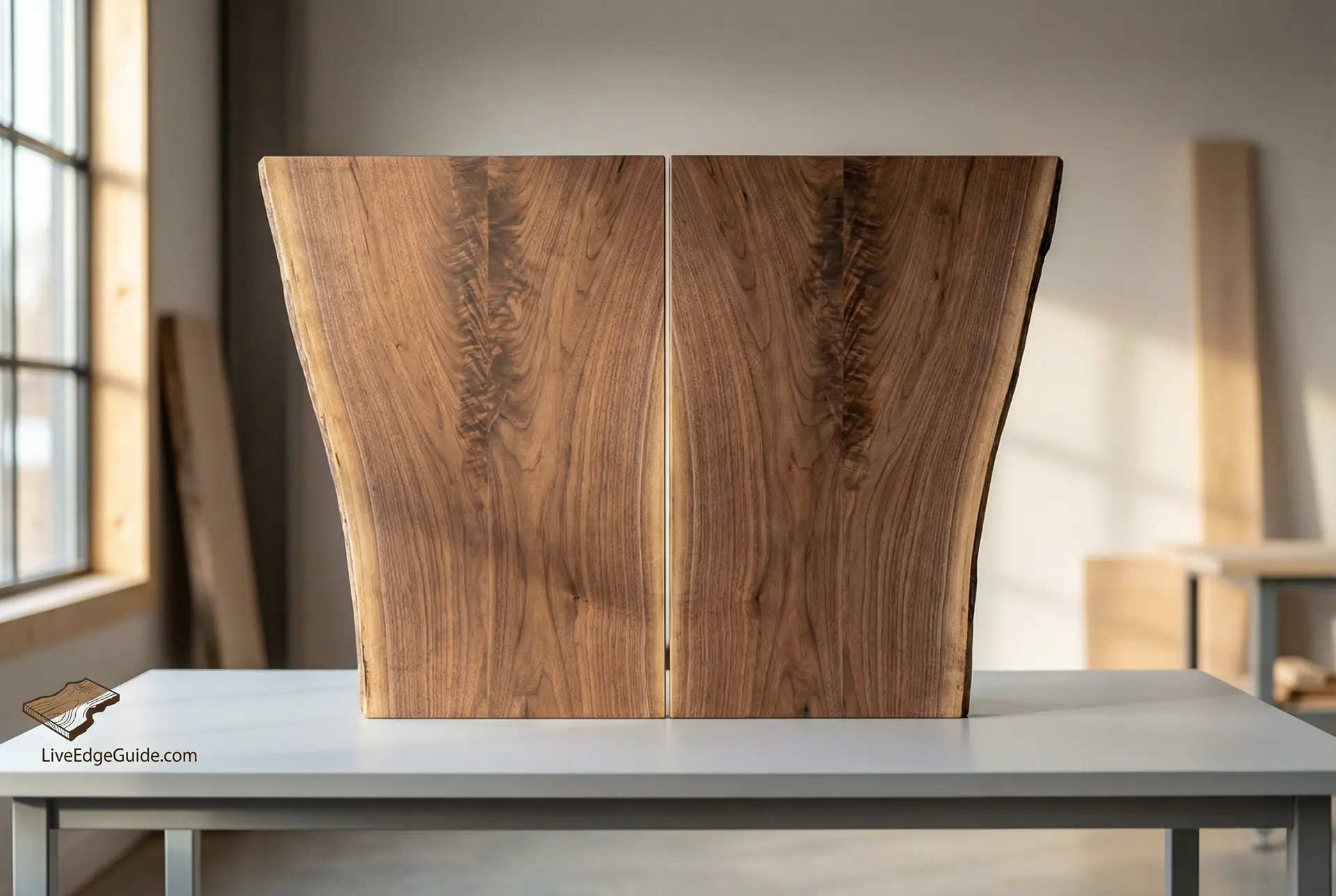
This involves slicing the entire log into consecutive slabs. This allows for Bookmatching, where two slabs from the same flitch are joined to create a mirror image.
2. Boulle Sawn
A "Boulle" is an entire log that has been sliced and then put back together with spacers for drying. Buying a "Boulle" ensures that every piece of furniture in a large room (dining table, coffee table, and shelving) is perfectly color-matched.
3. Quarter-Sawn vs. Plain-Sawn
- Plain-Sawn: The most common for live edge. It captures the natural "cathedrals" in the grain.
- Quarter-Sawn: Sliced at an angle to the growth rings. This produces the most stable wood with the least amount of movement, though it often eliminates the live edge on one side.
Sourcing and Sustainability
The most responsible live edge furniture comes from salvaged or sustainably harvested trees.
- Salvaged Logs: Trees fallen by storms or removed for safety.
- Fast-Growing Species: We champion Parota because it grows incredibly fast in tropical climates, making it a renewable resource compared to old-growth Oak or Walnut.
[!TIP] Always ask your furniture maker about the origin of their wood. Sustainable sourcing ensures we can enjoy these natural masterpieces without depleting forests. Read our full Global Wood Sourcing & Ethics Guide.
The Critical Importance of Kiln Drying
If there is one thing you take away from this guide, let it be this: Air drying is not enough.
Live edge slabs are massive. To be stable in a climate-controlled home, they must be kiln-dried to a moisture content of 6-8%.
- Air Dried: Often sits at 12-15% or higher. When brought inside, it will shrink, crack, and warp.
- Kiln Dried: Heat and airflow remove moisture deep within the cellular structure, "setting" the wood shapes.
Learn more about our Fabrication Process
Take the Checklist to the Showroom
Don't get stuck with a low-quality slab. Download our printable 12-point buying checklist to use while shopping.
Built for DFW Homeowners • No Spam Ever
Wood Hardness and Durability: The Janka Scale
When choosing a live edge table, "hardness" isn't just a feeling—it’s a scientific measurement. The Janka Hardness Scale measures the force required to embed a 0.444-inch steel ball halfway into a piece of wood.
Understanding this scale is critical for matching a slab to its intended use (e.g., a heavy-use family dining table vs. a decorative hallway console).
| Species | Janka Rating (lb-f) | Use Case Recommendation | | :--- | :--- | :--- | | Hickory / Pecan | 1,820 | Extremely high-use. Practically indestructible. | | White Oak | 1,360 | High-use. The industry standard for hardness. | | Black Walnut | 1,010 | Moderate-use. Standard for beauty and workable density. | | Parota | 950 | Moderate-use. Similar to Walnut, but lighter. | | Cherry | 950 | Light to Moderate-use. Ages beautifully with light. | | Cedar | 350 | Decorative only. Too soft for a functional dining table. |
Density and Weight
Higher Janka ratings usually correlate with higher weight and density. A 10-foot White Oak table can weigh over 400 lbs, requiring a heavily engineered base. A Parota table of the same size will be significantly lighter due to its unique cell structure, making it easier to transport and install without sacrificing visual presence.
The Art of the Imperfect: Understanding Wood Figure
In traditional woodworking, a knot or a crack is seen as a defect. In live edge design, these are the "signatures" of the tree. Here are the premium figures you should look for:
1. Burl
A burl is a large, rounded outgrowth on a tree trunk filled with small, swirling knots. This produces a "popcorn" or highly chaotic grain pattern that is incredibly rare and highly valuable.
2. Spalting
Spalting is a form of wood coloration caused by fungi. When correctly stopped by the kiln-drying process, it creates jagged, black "line art" through the grain that looks like a pen-and-ink drawing.
3. Crotch Wood (Flame Grain)
Where a large branch splits from the main trunk, the wood fibers are compressed, creating a "V" shape or "Flame" pattern. This is often the most dramatic section of a slab.
4. Quilted and Curly Figure
This is a ripple effect in the grain that creates a 3D, holographic look. When light hits a "curly" Maple or Walnut slab, the wood appears to move as you walk around the table.
5. Voids and Checks
- Checks: Small cracks that run along the grain.
- Voids: Natural holes where a branch once was.
- The Fix: These are typically filled with clear or black epoxy to create a smooth surface while preserving the visual depth of the hole.
Choosing the Right Wood Species
1. Parota (Guanacaste)
- Best For: Large dining tables, conference tables.
- Pros: Massive widths (single slabs), lightweight, water-resistant, sustainable.
- Cons: Softer than oak (requires a hard finish).
- Read our Full Parota Guide
2. Black Walnut
- Best For: Desks, coffee tables.
- Pros: Classic dark look, high density.
- Cons: Expensive, smaller widths require glue-ups.
3. White Oak
- Best For: Minimalist, Scandinavian styles.
- Pros: Hard, durable, neutral color.
- Cons: Very heavy, prone to checking if not dried perfectly.
Recommended Reading
- Texas Pecan Deep Dive: Why native Pecan is the ultimate hard-use table wood.
- Texas Mesquite Analysis: Exploring the legendary stability of Texas's most iconic shrub-tree.
- Live Edge Pricing Guide: What to expect when budgeting for a premium slab.
- Table Sizing Calculator: Find the perfect dimensions for your room.
Ready to find your perfect slab?
Explore our curated collection of kiln-dried Parota slabs ready for custom finishing.
Browse Slab CollectionFinishes: Oil vs. Polyurethane
| Feature | Hardwax Oil (Rubio Monocoat) | Polyurethane / Lacquer | | :--- | :--- | :--- | | Look | Natural, matte, "wood" feel | Glossy or Satin, "coated" feel | | Protection | Good liquid resistance, easy repair | High scratch resistance | | Maintenance | Re-oil yearly | Difficult to spot-repair |
For most residential dining tables, we recommend a high-quality Hardwax Oil or a specialized Nano-coating that preserves the texture of the wood while repelling wine and water.
Designing Your Table
When commissioning a live edge table, consider:
- Size: Allow 24-30 inches of width per person.
- Base: Metal legs offer stability for heavy slabs; wood bases offer a cohesive look.
- Epoxy: Do you want a "river table" or just cracks filled? Read our Live Edge vs. Epoxy comparison.
Sustainability: The Ethics of Live Edge
In an era of "fast furniture," live edge wood stands as an antidote to environmental waste. However, not all live edge is created equal. Understanding the provenance of your wood is a critical part of being a responsible buyer.
1. Urban Salvage
Many of the best slabs come from "hazard trees"—trees in urban areas that must be removed due to disease, storm damage, or construction. Instead of being chipped for mulch or thrown in a landfill, these logs are "rescued" and milled into slabs. This is the most eco-friendly way to source wood.
2. The Parota Miracle
We focus on Parota (Enterolobium cyclocarpum) because it is one of the most sustainable tropical hardwoods on the planet.
- Rapid Growth: Parota trees can reach maturity in just 20-30 years, whereas a comparable White Oak might take 100+ years.
- Carbon Sequestration: Because they grow so fast, they are highly efficient at pulling carbon out of the atmosphere.
- Abundance: It is the national tree of Costa Rica and grows abundantly across Central and South America without being listed on CITES (Endangered Species) lists.
- Verified Sourcing: Visit the Kovara Parota Gallery to see currently available, kiln-dried specimens verified for ethical harvesting.
3. The 100-Year Lifecycle
The ultimate sustainability of a live edge table lies in its longevity. A piece of furniture made from particle board and plastic will end up in a landfill within 5-10 years. A solid wood slab table, when properly cared for, will last for centuries. It can be sanded down and refinished by your grandchildren, making the "carbon footprint" per year of use incredibly low.
Final Summary and Next Steps
By now, you understand that a live edge table is more than just a piece of furniture—it is a biological record, a work of art, and a generational investment. Whether you choose the massive presence of Parota, the classic elegance of Walnut, or the rugged durability of Texas Pecan, you are bringing a piece of the forest into your home.
Ready to Start Your Journey?
- Step 1: Use our Table Sizing Calculator to find your ideal dimensions.
- Step 2: Read the 7 Questions to Ask Your Maker to ensure quality.
- Step 3: Explore our Gallery for base design and epoxy inspiration.
- Step 4: Consult the Live Edge Wood Care Guide to ensure you're prepared for long-term ownership.
The perfect slab is waiting.
Our inventory updates weekly with the finest kiln-dried Parota and Texas hardwoods.
View Live InventoryFrequently Asked Questions
What is live edge wood?
Live edge wood refers to lumber that retains the natural edge of the tree, often including the bark or the organic shape of the trunk, rather than being cut into straight, square edges.
Is live edge furniture durable?
Yes, when properly kiln-dried and finished, live edge furniture is extremely durable and can last for generations. The key is in the drying process to prevent warping.
What is the best wood for a live edge table?
Parota (Guanacaste) is a top choice due to its large size, fast growth (sustainability), and resistance to decay. Walnut and Oak are also popular but often more expensive and slower-growing.